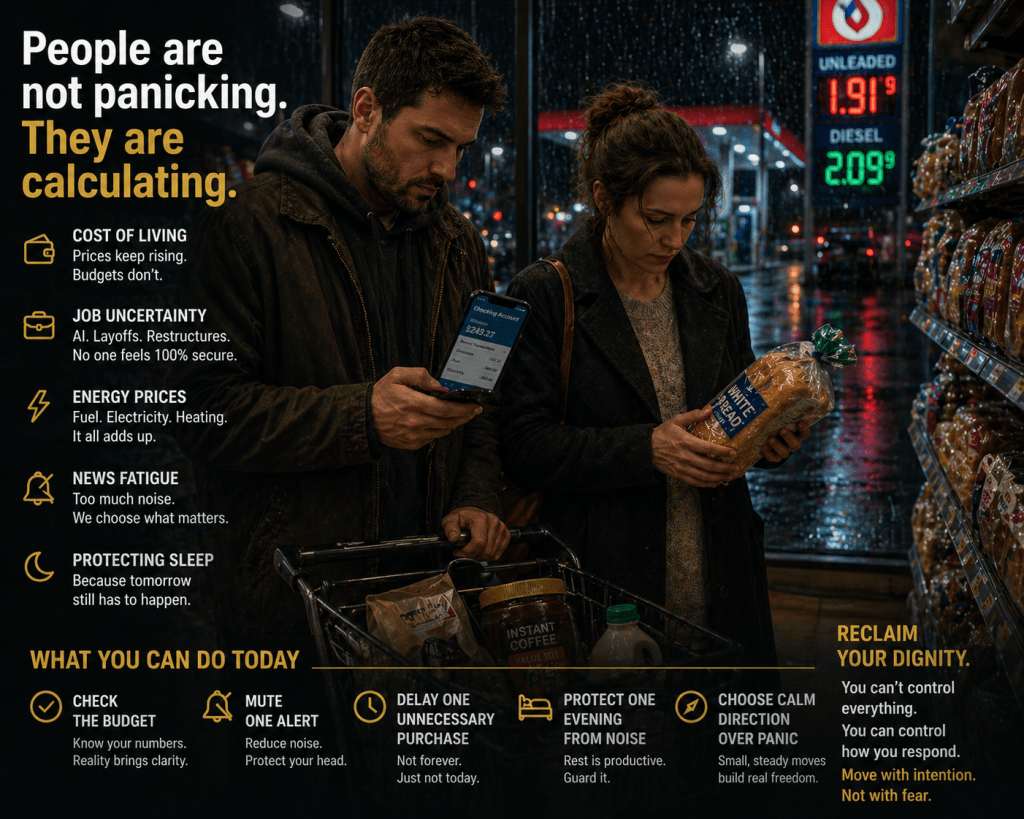
He stands in the shop with one hand on the basket and one hand on his phone.
Not because he is broke.
Not because he has given up.
He is just doing the small calculation again.
Fuel. Food. Rent. Work. The next bill. The thing he almost bought, but now puts back on the shelf.
Something is changing in how people live with the news.
Mainstream news used to feel like something happening outside the house. Markets, wars, inflation, layoffs, interest rates, oil prices, elections, AI. Big words. Big screens. Big people talking.
Now it lands directly in the hallway.
It lands when people check petrol prices before visiting family.
It lands when they delay replacing the old phone.
It lands when they stop saying yes to every dinner out.
It lands when they keep a job they no longer love because “stable” has started to sound better than “exciting”.
It lands when they mute news alerts because the phone has started to feel like a siren in their pocket.
People are not necessarily becoming colder.
They are becoming more careful.
They read the headline, but skip the argument underneath.
They check the bank app more often.
They save a little more if they can.
They wait one more month before buying.
They ask whether AI is coming for their job, even if nobody at work says it out loud.
They watch companies cut staff while talking about efficiency and innovation, and they understand the message clearly enough.
The uncomfortable truth is this:
A lot of people do not trust that the system will catch them if things go wrong.
So they are building smaller lives around self-protection. Fewer risks. Fewer open tabs in the brain. Fewer promises. Fewer “let’s just see what happens.”
That can look boring from the outside.
But from the inside, it feels like survival with manners.
The positive truth is this:
People are not all asleep. They are adapting.
They are learning to filter noise.
They are choosing fewer but better sources.
They are protecting sleep.
They are talking more honestly about money.
They are noticing that not every crisis deserves full emotional access to their day.
The contrast is sharp.
People want to stay informed, but they do not want to be consumed.
They want truth, but not a nervous system full of fire alarms.
They want ambition, but not if every plan depends on pretending the world is stable.
That matters because this is where dignity begins again.
Not in pretending everything is fine.
Not in doomscrolling until the body gives up.
But in the small adult choices.
Put the item back.
Mute the alert.
Check the budget.
Keep your head clear.
Move slower if you need to.
Build something that can survive bad headlines.
People are not panicking.
They are calculating.
And honestly, that may be the sanest thing happening right now.
People Are Not Panicking. They Are Calculating.
Response
-
1. Reuters — UK consumers turn most downbeat since 2023 amid Iran war concerns Link: https://www.reuters.com/world/uk/uk-gfk-consumer-sentiment-index-drops-lowest-since-2023-2026-04-23/ Summary: Shows declining consumer confidence, rising price expectations, and increased saving behavior as a form of everyday financial self-protection.2. Reuters — Companies cutting jobs as investments shift toward AI Link: https://www.reuters.com/business/world-at-work/companies-cutting-jobs-investments-shift-toward-ai-2026-04-15/ Summary: Highlights how AI investments and efficiency strategies are making job insecurity more real and immediate in everyday working life.3. Reuters Institute — Digital News Report 2025 (News Avoidance) Link: https://reutersinstitute.politics.ox.ac.uk/digital-news-report/2025/dnr-executive-summary Summary: Shows a rise in selective news avoidance and changing patterns in how people consume and filter information.Brand link:Reclaiming Dignity — https://reclaimingdignity.net
LikeLike

 Reclaiming Dignity
Leave a reply to Reclaiming dignity Cancel reply