He sits in the car before work and does the math again.
Rent. Food. Fuel. Debt. One course. Maybe a certificate. Maybe trade school. Maybe staying where he is for six more months even though the job is draining him.
Not because he has no ambition.
Because ambition without a plan has started to look expensive.
Something is shifting in how men think about work and direction. The old career advice does not land the same way anymore. “Follow your passion” sounds thin when AI is cutting office jobs, college debt still follows people home, and a stable title no longer means a stable life.
So men are getting more practical.
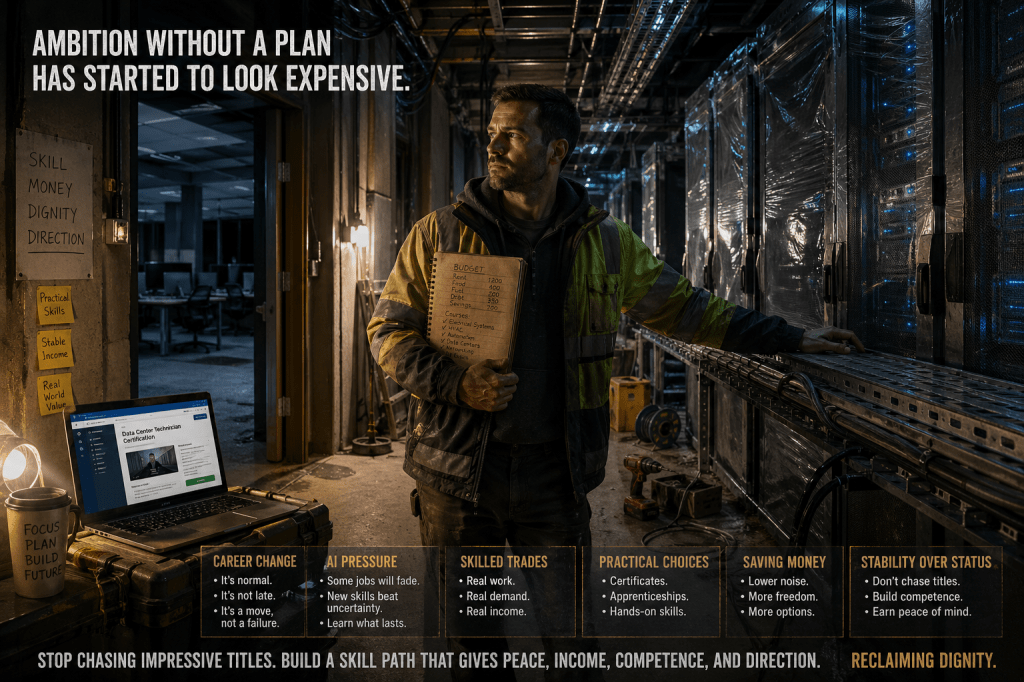
Some are looking at trades again. Electrical work. HVAC. Construction. Automation. Data centers. Anything where the work touches real systems, real tools, real infrastructure. Not because every man suddenly wants to wear boots and carry a toolbox, but because physical competence has started to look safer than vague corporate usefulness.
Some are learning AI at night because they do not want to be the guy who gets replaced by someone using it. Some are leaving big companies and trying small startups because the “safe job” stopped feeling safe. Some are staying quiet, stacking money, taking fewer risks in public, and planning their exit privately.
You can see it in small choices.
A man stops laughing at the idea of trade school. He asks what an electrician actually earns. He watches videos about automation instead of motivational clips. He updates his CV but does not send it yet. He stays late one night, not out of loyalty, but because he is studying the system. He stops buying useless stuff because he may need six months of runway. He takes the boring course because boring might pay. He stops asking, “What sounds impressive?” and starts asking, “What still exists in ten years?”
That is the real change.
Men are not just chasing status. A lot of them are trying to build a life that cannot collapse because one manager, one algorithm, or one market shift decides they are no longer needed.
The uncomfortable truth is that some men are not “lazy.” They are lost. And when every path looks risky — university debt, unstable office jobs, trades with hard physical demands, entrepreneurship with no safety net — some men freeze. They do not choose. They drift. And drifting quietly destroys years.
But there is also a positive truth people miss.
Many men are adapting faster than the stereotype says. They are not sitting around waiting to be saved. They are changing tools, changing fields, changing expectations. They are becoming more practical, less romantic about work, and more honest about what a career has to do: pay, hold, teach, and leave some dignity intact.
The contrast matters.
On one side, more people praise skilled work, hands-on competence, and “AI-proof” careers. On the other side, too few young people still choose those paths early. So men are stuck between cultural talk and real-world action. Everyone says practical skills matter. But the system still rewards the appearance of status until the bill arrives.
That gap is where a lot of men are living right now.
Not broken.
Not fully confident either.
Just standing in the middle of a changing labour market, trying to choose a direction that will not make them feel stupid five years from now.
And maybe that is the new version of ambition.
Not chasing the biggest title.
Choosing the path that lets you keep your footing.
Men Are Choosing Careers That Can Survive Reality
Response
-
1. Reuters — Denmark’s Green Skills Gap https://www.reuters.com/sustainability/society-equity/how-companies-are-working-with-denmark-plug-its-green-skills-gap–ecmii-2026-01-06/ Summary: Denmark is facing a shortage of nearly 10,000 electricians and electrical technicians needed for the green transition. This highlights how skilled technical trades are becoming increasingly critical. 2. SMVdanmark / Ritzau — Only 19% Apply to Vocational Education https://via.ritzau.dk/pressemeddelelse/14848706/nye-tal-ikke-siden-2017-har-sa-lille-en-andel-af-de-unge-sogt-ind-pa-erhvervsuddannelserne?lang=da&publisherId=13559667 Summary: New 2026 data shows the lowest share of young people applying to vocational education in nine years. Clear contrast: demand for skilled workers is rising, but too few are choosing this path. 3. Gallup — Rising AI Adoption Spurs Workforce Changes https://www.gallup.com/workplace/704225/rising-adoption-spurs-workforce-changes.aspx Summary: AI is actively reshaping jobs, staffing, and productivity. This helps explain why more people are moving toward practical, resilient career paths. Brand link: Reclaiming Dignity — https://reclaimingdignity.net
LikeLike

 Reclaiming Dignity
Leave a comment